
Skin Cancer Facts
You Should Know
At Penrith Skin Cancer Clinic, we eagerly share what we know so that patients grow increasingly aware of the important skin cancer facts. This helps you understand why certain medical, surgical, or laser procedures are necessary for treatments to be successful.
Basal Cell Carcinoma (BCC)
One of the most common types of skin cancer (80%), BCC forms in the skin’s basal cells. Mostly occurring in the sun-exposed areas of the face (mainly), neck, upper trunk, and limbs (10%), it develops slowly over the years. Usually caused by cumulative sun exposure, these look like open sores, red patches, pink growths, shiny bumps or scars. BCC rarely spreads via lymph nodes or through the bloodstream. This can be a problem if these skin growths spread deeply around the nose, eyes or ears.Clinical Types
- Cystic Nodular: Translucent or Pale Grey
- Ulcerated: Nodular BCC With Ulcer on Top
- Pigmented: Usually Spotted, Amt Be Black
- Superficial: Red/Pink Patch
- Morphoeic (Fibrotic): Scar-Like, Difficult to Appreciate Margins
Management
- Surgical: Excision with 3 to 4 mm margin
- Radiotherapy: An option for frail people
Mohs Micrographic - Surgery: Surgical treatment for large or recurrent tumours or those in site when maximal tissue needs to be preserved
- Photodynamic Surgery: Response rate is less than 90% for nodular and superficial BCC
Squamous Cell Carcinoma (SCC)
Squamous cell carcinoma is an uncontrolled growth of abnormal cells arising in the squamous cells that make up most of the skin’s upper layers. It may look like red patches, open sores, elevated growths or warts that may crust or bleed. SCCs most commonly occur on sun-exposed areas, such as the ears, lips, face, balding scalps, necks, arms, hands and legs. These can spread and may involve regional lymph nodes.Management
- Surgical: Early excision of the tumour with a 4 mm margin to the deep-fat level
- Specialised surgery and or radiotherapy if large and found in difficult sites or if there is lymph node involvement
Bowen’s Disease
Bowen’s disease is a superficial SCC in situ of the skin that grows slowly, has well-defined margins, is thick, and may appear as red plaques. Lesions may remain unchanged for months or years.
Management
- Diagnostic Biopsy
- Surgery (If small)
- Imiquimod Treatment
Atypical Moles
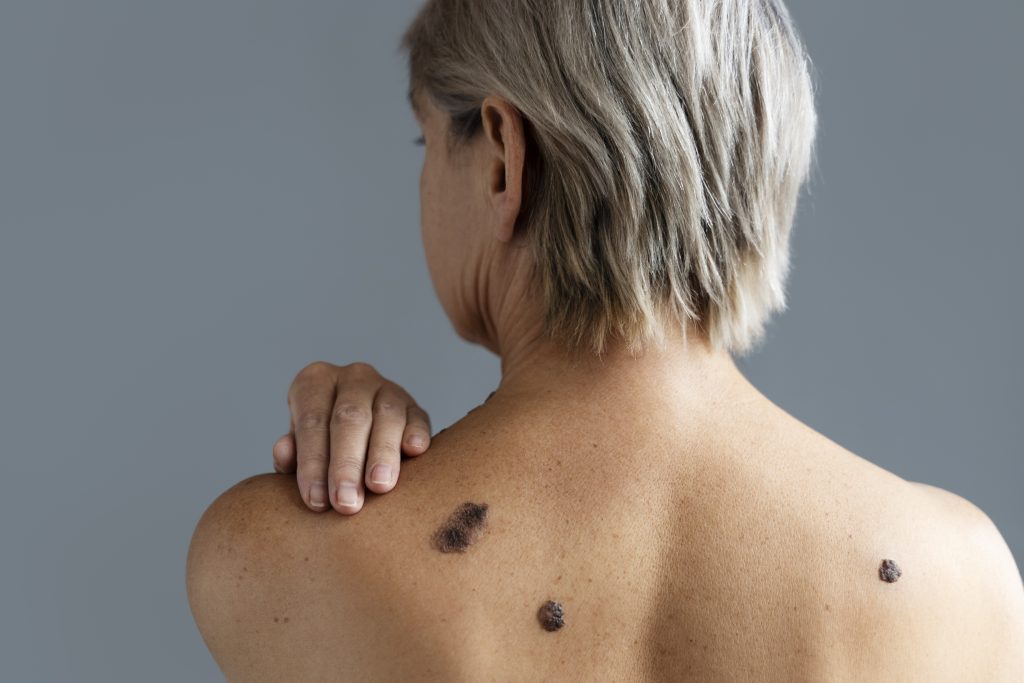
Unusual-looking moles, also called dysplastic naevi, may look like melanoma. People who have them have a higher risk of developing melanoma. Heredity also contributes to the development of atypical moles.
The more atypical moles a person has, the higher the risk of developing melanoma. Proper sun protection, regular personal head-to-toe and professional skin checks are necessary to prevent this.
Solar Keratosis
Also called actinic keratosis, these are scaly spots found on the sun-damaged skin. Considered precancerous, solar keratosis may progress to cutaneous squamous cell carcinoma. This is abnormal skin cell development due to UVB-induced DNA damage.Management
- Cryotherapy Using Liquid Nitrogen
- Shave Curettage and Electrocautery
- Surgical Excision Field Treatment With: Diclofenac Gels
- 5-Fluouracil
- Imiquimod Cream
- Photodynamic Therapy Ingenol Mebutate Gel
Melanoma
This is the most dangerous form of skin cancer, most often caused by ultraviolet radiation from the sunshine or tanning beds. There is uncontrolled growth of melanocytes (pigment cells), which are black or brown and can appear skin-toned, pink, red, blue, purple, or white. Having regular skin checks can help diagnose melanoma in its early stages. If cancer growth spreads to other parts of the body, it becomes hard to treat and may cause death.Who Gets Melanoma?
The highest reported rates of melanoma in the world are in Australia and New Zealand. The factors include:- Increasing Age
- Previous Invasive Melanoma or Melanoma In Situ
- Previous Basal or Squamous Cell Carcinoma
- Many Melanocytic Naevi
- Multiple Atypical Moles (Greater Than Five)
- Strong Family History of Melanoma (With Two or More First-Degree Relatives Affected)
- White Skin That Burns Easily
The ABCDEs of Melanoma
- A – Asymmetry
- B – Border Irregularity
- C – Colour Variation
- D – Diameter Over 6 mm
- E – Evolving (Enlarging, Changing)
Management of Melanoma
Depending on melanoma thickness, excision procedures follow diagnosis. Enlarged local lymph nodes are removed, while unenlarged ones are tested to see if there is any spreading. In cases of widespread melanoma, new or experimental treatments may be offered.Melanoma Prevention Guidelines Tips
- Do not burn skin
- Seek the shade
- Avoid tanning
- Cover up with clothing, a broad-brimmed hat and UV-blocking sunglasses
- Apply sunscreen (with SPF 15 or higher) on skin every day
- Use water-resistant, broad-spectrum (UVA/UVB) sunscreen (with SPF 30 or higher) when staying long in the sun
- Apply sunscreen over the entire body 30 minutes before stepping outdoors Reapply sunscreen every two hours or after swimming or sweating excessively
- Examine your skin head-to-toe every month
- See a physician every year for professional skin exams